
English and Mandarin both use pitch, but they use it differently.
Pitch (音调 / 音高) is the physical height of the voice—how fast the vocal folds vibrate. Every language uses pitch.
Tone (声调) is pitch used at the syllable or word level to change word meaning. In Mandarin, the same syllable with different tones is a different word: 妈 mā (mother), 麻 má (hemp), 马 mǎ (horse), 骂 mà (to scold). English has almost no lexical tones—changing pitch on more does not create a new dictionary word.
Intonation (语调) is the pitch contour across a phrase or sentence. It marks attitude, certainty, and speech acts (statement vs question). Both languages have intonation; English leans on it more heavily because it has no tone system to carry meaning at the word level.
The contours can sound alike—English fall ≈ Mandarin fourth tone, rise ≈ second, fall–rise ≈ third—because they share the same acoustic material (pitch going up or down). The jobs differ: Mandarin tones label words; English intonation shapes utterances. Saying Cat↑? or Cat↓. does not change the word cat; it changes whether you are asking or stating.
Stress (重音) is which syllable or word is louder, longer, and clearer. English is roughly stress-timed: stressed beats stay fairly even, and weak syllables get compressed. Mandarin is closer to syllable-timed: syllables tend to take more equal time. That is why Chinese-influenced English often sounds flat or evenly paced—every syllable is "full." Stress comes later in this post; the sections below focus on intonation shapes.
Notation in examples: bold = stressed word; optional underline marks peak stress when multiple bold words differ in weight (see stress post). The last bold word in a thought group is the nucleus; ↓ fall, ↑ rise, ↓↑ fall–rise, ↑↓ rise–fall, → level. Arrows sit right after the nucleus, with no space.
Intonation patterns
The audio and reference images are exaggerated to help you learn. The first track is the contour on a [m] sound. The second track is the word more said slowly with the same contour.
In normal conversation, these movements are rarely this big—but starting exaggerated makes the shapes easier to hear and copy.
Level →

Use for: unfinished thought, routine / neutral listing (mid-items), flat or mechanical feel, being interrupted before a landing.
Let me see→ …
Busy→, but fun↓.
One, two→, three→ …
Fall ↓

Use for: finished statements, certainty, Wh- questions, commands, exclamations; also check questions (confirming what you already think).
I live here↓.
Where are you from↓?
Come in↓!
Really↓.
Are you sure↓? (check: "as I thought?")
Rise ↑

Use for: yes/no (closed) questions, uncertainty, politeness, friendly backchannel, "more coming" / incomplete.
Are you sure↑?
Really↑?
Can you help↑?
If you want↑ …
Oh, nice↑!
Fall–rise ↓↑
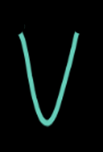
Use for: reservation, soft disagreement, doubt, implied contrast, polite correction—"yes, but…" without saying but.
Are you sure↓↑?
Really↓↑?
I know↓↑ …
Do you not believe↓ me↑?
Rise–fall ↑↓
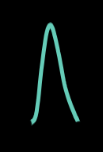
Use for: strong feeling, admiration, emphasis, animated surprise (or heavy sarcasm).
Really↑↓?
It's amazing↑↓!
Are you sure↑↓?
Same phrase, different meaning
Are you sure↓ / ↑ / ↓↑ / ↑↓
Really↓ / ↑ / ↓↑ / ↑↓
↓ settles; ↑ asks or softens; ↓↑ holds back; ↑↓ loads emotion.
One word or across words
Mandarin tones finish inside one syllable. English fall–rise and rise–fall do not have to. They can sit on a single word, or stretch across two (or more) words—longer, slower, and not "one beat like 马 mǎ."
On one word (contour inside the word; often on the stressed syllable):
But↓↑
Actually↓↑
Really↓↑?
Really↑↓?
Across words (fall on one stressed word, rise or fall on the next):
Do you not believe↓ me↑?
I know↓ what you mean↑.
That's not↑ what I meant↓.
If you map every English syllable to 阴平 / 阳平 / 上声 / 去声, the sentence will sound like recited characters, not English intonation. Treat the utterance as one pitch line, with the big turn mainly on the nucleus (and any word the contour continues onto)—not a new Mandarin tone on each syllable.
Hearing the difference
Same words, different contours—meaning changes. (Hear it at https://www.youtube.com/watch?v=Fl6q3hTHfhI&t=293s)
Do you not believe↓ me↑?
Many learners hear this as flat (level →). It is often fall–rise spread across two words: the pitch drops on believe, then rises on me—a challenge or "come on, really?" feel, not a calm statement.
Really↓?
Really↓↑?
A plain fall can sound like a finished reaction. Fall–rise often softens or questions the previous claim ("I'm not sure I buy that").
Practice tip: hum the contour on [m] or more first—think "draw a line," not "which of the four tones is this?" Then speak while drawing the contour with your hand. Mute the meaning for a moment and listen only for whether the pitch goes down, up, or both.
Practical patterns
A flat, level pitch often sounds less engaged. These patterns are everyday ways to add shape. (Ideas drawn from Why Your English Sounds Flat and How to Stop Sounding Robotic.)
Friendly rise ↑
Use ↑ for interest, warmth, or a yes/no (closed-question) feel—not only for literal questions.
What's your name↓? vs What's your name↑?
Really↑?
Oh, nice↑!
Are you serious↑?
That's really great↑!
Confident fall ↓
Use ↓ to finish a statement with certainty.
I live in Spain↓.
I'm an English teacher↓.
I took the IELTS test last year↓.
Contrast ↑ … ↓
On two contrasting ideas, rise on the first, fall on the second.
I like coffee↑, but today I prefer tea↓.
It was difficult↑, but it was worth↓ it.
Some people think | social media is harmful↑, but others say it's useful↓.
It's a nice idea↑, but it's too expensive↓.
Lists ↑ … ↑ … ↓
Non-final items rise (more coming); the last item falls (done).
Yesterday, I went to the gym↑, did some weights↑, then had some lunch↓.
Last week, I travelled to London↑, visited a few museums↑, and tried some amazing food↓.
Rise–fall ↑↓ (emotion)
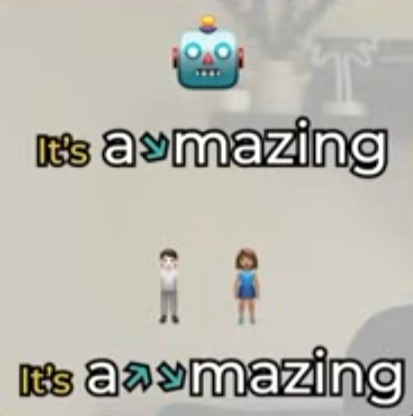
Plain fall can sound factual. Rise–fall often adds surprise, strong feeling, or animation.
It's amazing↓.
It's amazing↑↓.
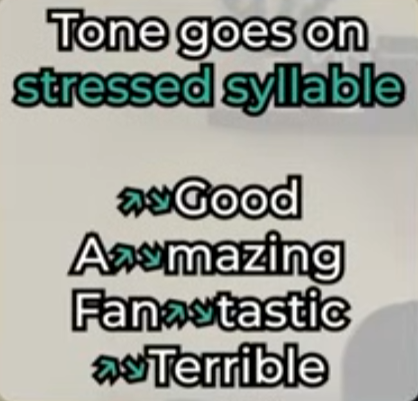
Stress + rhythm (anti-robotic)
Bold = content words (stress them). Leave function words light. Put the big pitch turn on the nucleus—usually the last stressed word in the thought group—not a rise on every content word.
I need to finish the project↓.
I need to finish the project | by two o'clock↓.
So I'll talk to you later↓.
Slightly slower, controlled speech often reads as calm and confident; rushing every syllable can sound tense even when the words are correct.
Mini dialogue
How was your day↑?
Busy→, but fun↓.
Oh really↑? What happened↑?
I had a presentation↑, did an exam↑, went to the gym↑, and then came home↓.
References
- Does your English sound flat? Improve Your Intonation!
- Sentence Stress and Intonation in English (The Complete Guide)
- English pronunciation secret (english.cool)
- Why Your English Sounds Flat — Fix Your Intonation in 10 Minutes
- 5 Easy Ways to Sound More Like a Native Speaker
- How to Stop Sounding Robotic: Use Stress and Intonation to Sound Natural in English